
A static calf contraction pushing the foot down into plantar flexion against a band, with no movement. This gentle isometric loads the calf and ankle early in rehab, before progressing to moving exercises. A well-tolerated starting point for calf and Achilles loading.

A static calf hold performed with the balls of the feet on a step edge, sustaining a raised-heel position over the step. Using the step allows a fuller position while still loading the calf without movement. A pain-friendly way to build early calf strength through a slightly greater range.

A static heel-raise hold, holding the body up on the balls of the feet to load the calf without any movement. Isometric holds are a gentle, well-tolerated way to begin calf strengthening and can help calm Achilles symptoms. A common early-stage loading exercise.

A two-leg calf exercise lowering the heels first to neutral, then progressing to a full drop below the step. Gradually increasing the range builds calf strength and Achilles tolerance in manageable steps. An accessible early-stage heel-drop exercise.

A calf exercise that rises on two legs and lowers on one, combining a two-leg lift with a single-leg eccentric drop. This 'concentric on two, eccentric on one' method is a common way to bridge toward full single-leg work. A useful progression in calf and Achilles strengthening.

An eccentric single-leg calf exercise, lowering the heel below a step on one leg. Rising with help from both feet and lowering on one emphasises the controlled lengthening phase, a key approach in Achilles and calf rehab. An important strengthening drill once basic capacity has returned.

A single-leg balance exercise with added head turns to challenge stability further. Turning the head disrupts the balance system, forcing the ankle and hip to work harder to stay steady. A useful progression once basic single-leg balance is comfortable.

A static heel-raise hold, rising onto the balls of the feet and holding the position to load the calf without movement. Isometric calf holds are a well-tolerated early way to build strength and can help settle Achilles symptoms. A common starting point in calf and Achilles rehab.
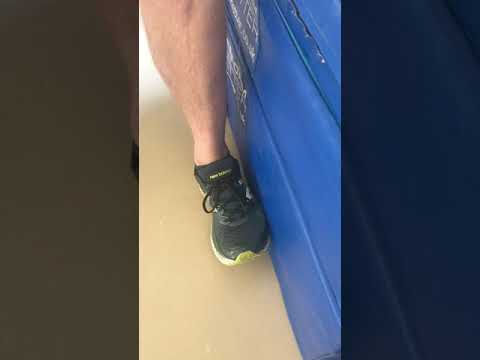
A static hold pushing the foot outward (eversion) against a fixed resistance, with no movement. This gentle isometric is an early way to load the outer ankle muscles, often after a sprain. A pain-friendly starting point before moving exercises.

A single-leg balance exercise performed on a Bosu or wobble cushion to increase the challenge. Controlling the wobble trains the ankle, hip and balance system together. Can be progressed with head turns or eyes closed for an added demand.

A squat performed on a Bosu or wobble surface to challenge balance and control. Managing the unstable base recruits the stabilising muscles around the ankle and knee while strengthening the legs. A progression that adds a balance element to the basic squat.

A lunge performed with a foot on a Bosu or other unstable surface to add a balance challenge. Controlling the wobble while lunging builds single-leg strength alongside ankle and knee stability. A mid-stage exercise combining strength with balance training.

Jogging on the spot with brief holds added to challenge balance and control. The light, repeated foot contacts reintroduce running-style loading, while the holds test single-leg stability. A useful early return-to-running and calf-conditioning drill.
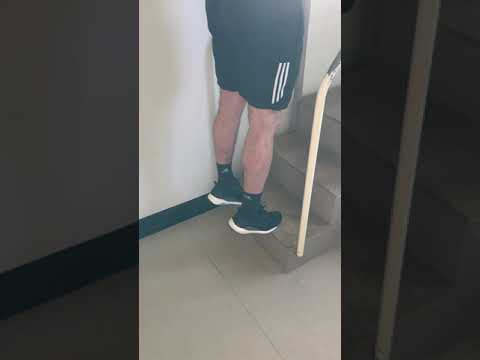
Calf raises performed over a step edge, progressing from two legs to one as strength allows. Lowering the heels below the step works the calf through its full range, and the single-leg version markedly increases the load. A staple for building calf strength and Achilles capacity.

A static ankle-eversion hold pushing the foot outward against a band, with no movement. This pain-friendly isometric strengthens the muscles on the outer ankle that help guard against the ankle rolling. A common early-stage exercise after ankle sprains.

Seated calf raises loaded with around 10kg resting on the thighs, biasing the soleus part of the calf. The bent-knee position shifts the work onto the soleus, which is important for walking, running and Achilles rehab. Adding the weight progresses the exercise to build strength and endurance.


A controlled on-the-spot jog to reintroduce light running-style loading.

Small, low-impact star jumps to introduce gentle hopping and ankle loading.

A maximal horizontal jump for developing lower-limb power and landing control.

An explosive split-stance jump alternating legs to build single-leg power.

A fast, springy single- or double-leg hop training lower-limb stiffness and power.
