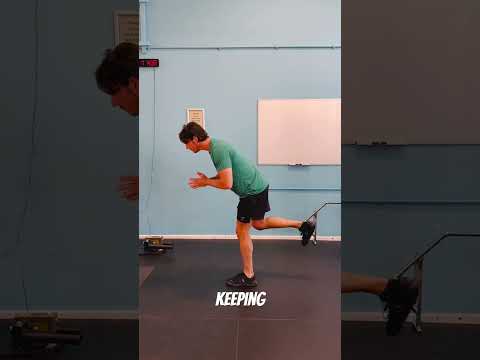
A hamstring and hip-mobility drill that moves through a hinge pattern resembling a diving motion. Builds hamstring strength and control through a dynamic range of motion.

A bridge variation performed with the knees bent to roughly 45 degrees, shifting more load onto the hamstrings. Strengthens the hamstrings through a knee-friendly range, useful in ACL and meniscus recovery.

A double-leg bridge that emphasizes hamstring and glute activation by driving through the heels. Builds posterior-chain strength that supports hip and knee rehab.

A single-leg glute and hamstring bridge that isolates one side at a time from a hook-lying position. Builds strength while exposing and correcting side-to-side imbalances, useful for hip arthritis, ACL, and meniscus rehab.

A standard double-leg hamstring curl on a stability ball, bridging the hips and curling the ball toward the body. Strengthens the hamstrings and glutes while training hip control.

A two-leg Swiss ball hamstring curl with an added cue for core bracing throughout the movement. Builds hamstring strength together with core stability, supporting ACL and meniscus rehab goals.

A single-leg hamstring curl performed on a stability ball, adding a balance and core demand to the movement. Strengthens the hamstrings unilaterally while challenging core control, useful for knee pain, ACL, and meniscus rehab.
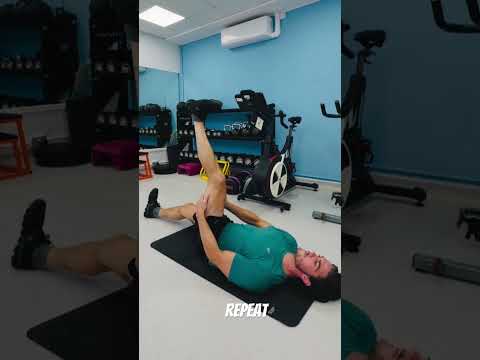
A hamstring flexibility exercise that combines a controlled stretch with active lengthening. Improves hamstring range of motion and control, supporting recovery from hamstring, ACL, or meniscus injuries.

A sliding hamstring exercise that emphasizes the eccentric, or lengthening, phase of the hamstring curl. Develops hamstring strength and control, commonly used in ACL and meniscus rehab programs.

An eccentric hamstring exercise using a slider to lower the body under control from a bridge position. Builds hamstring strength through lengthening, supporting rehab after ACL or meniscus injury.


Begin in a supine position with heels positioned on sliding pads, or towel; in contact with slide board, or other suitable surface. Lift your hips into extension with the shoulders, hips, and knees aligned, and the ankles in a dorsiflexed position; creating stiffness throughout.
Instructions:
Keep your elbows tucked in to your sides to help create a stable base of support to perform the movement. Slowly slide your heels out as far as you can keep controlled and return to starting position.
Reps:
Repeat 6 – 8 repetitions 3 sets. Progress to doing it with one leg (affected leg). Aim for 6 -8 repetitions 3 sets. To progress further you can hold weight to chest and Nordics are introduced.

The patient is lying supine with arms placed in a comfortable position, knees flexed and foot on a step.
Instructions:
The patient is instructed to raise their untested leg off the examination table and then perform repetitions of hip extension, where they push down through the heel of the tested leg and lift the hips off the ground towards full hip extension.
Reps:
Repeat 10 – 12 repetitions. Progress to doing it with one leg (affected leg). Aim for 8 repetitions 3 sets. To progress further you can hold weight to chest

Starting position:
The exercise is started with the patient positioned with upright trunk, one hand holding on to a support and legs slightly split. All the body weight should be on the heel of the injured leg with approximately 10–20° knee flexion.
Instructions:
The patient is instructed to perform a gliding backward movement on the other leg and stop the movement before pain is reached. The movement back to the starting position should be performed by the help of both arms, not using the injured leg.
Sets:
6 x 3
Progression is achieved by increasing the gliding distance and performing the exercise faster.

Starting position:
The patient is standing with full weight on his injured leg and the opposite knee slightly flexed backwards.
Instructions:
The patient is asked to perform the exercise as a simulated dive (hip flexion from an upright trunk position) of the injured, standing leg and simultaneous stretching arms forward and attempting maximal hip extension.
Sets:
6 x 3
*Good quality, keep pelvis horizontally throughout the whole movement
*Maintain 10–20° knee flexion in the standing leg.

Starting position:
The patient is lying supine, holding and stabilise the thigh of the injured leg with the hip flexed approximately 90°.
Instructions:
The patient is instructed to perform slow knee extensions to a point just before pain is felt.
Sets:
12 x 3, 2 x per day
Progression:
Increase speed.
