Deep Gluteal Pain Syndrome (DGPS)

Helping You Get Back to Doing What You Love
Deep gluteal pain syndrome (DGPS) is an increasingly recognised cause of persistent buttock pain. It occurs when the sciatic nerve becomes irritated or compressed as it travels through the deep muscles behind your hip.
Although symptoms can be uncomfortable and frustrating, the outlook is excellent. Most people recover well with the right combination of education, progressive exercise and physiotherapy.
At Rebuild Physiotherapy, we specialise in diagnosing complex hip and pelvic conditions. Our rehabilitation programmes are designed to restore strength, movement and confidence, helping you return to everyday life, work and sport.
Understanding Your Hip
The Deep Gluteal Space
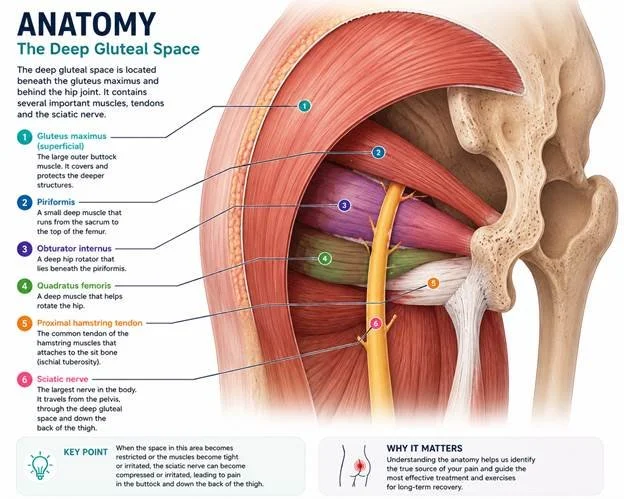
The deep gluteal space lies underneath the gluteus maximus (your largest buttock muscle) and behind the hip joint.
Several important structures occupy this relatively small area, including:
The sciatic nerve
Piriformis
Obturator internus
Gemellus superior
Gemellus inferior
Quadratus femoris
Proximal hamstring tendon
Blood vessels
Normally these structures move freely against one another as you walk, squat, bend and exercise.
When movement becomes restricted, inflammation develops or the available space narrows, the sciatic nerve can become irritated.
Did You Know?
Many people refer to this problem as Piriformis Syndrome.
Current research shows the piriformis muscle is only one possible cause of sciatic nerve irritation. Several muscles, tendons and surrounding tissues may contribute, which is why healthcare professionals now use the term Deep Gluteal Pain Syndrome.
What Causes Deep Gluteal Pain Syndrome?
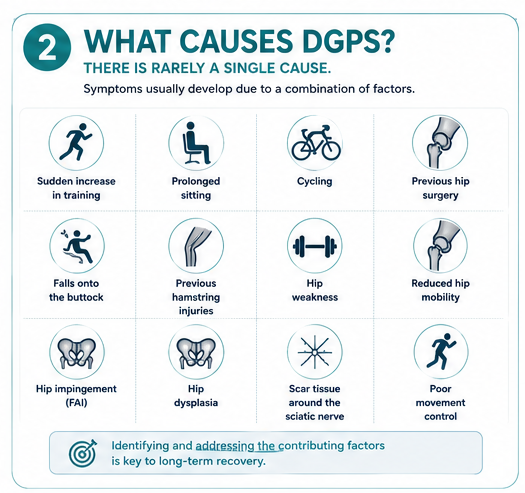
There is rarely a single cause.
Instead, symptoms usually develop following a combination of factors.
Common contributors include:
Sudden increases in running or training
Prolonged sitting
Cycling
Previous hip surgery
Falls onto the buttock
Previous hamstring injuries
Hip weakness
Reduced hip mobility
Hip impingement (FAI)
Hip dysplasia
Scar tissue around the sciatic nerve
Poor movement control#
Who Gets Deep Gluteal Pain Syndrome?
The condition is commonly seen in:
Runners
Cyclists
Weightlifters
Court sport athletes
Manual workers
Office workers who sit for prolonged periods
Patients recovering from hip surgery
Women appear slightly more likely to develop the condition due to differences in pelvic anatomy and hip biomechanics.
Symptoms
Everyone experiences symptoms differently, but common complaints include:
Deep buttock pain
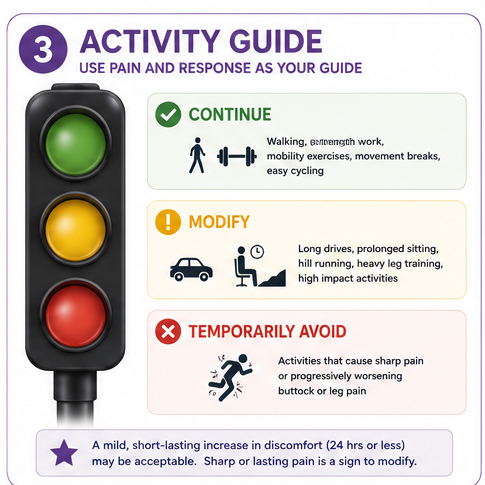
Pain sitting for long periods
Pain driving
Pain climbing hills or stairs
Pain when running
Tenderness deep within the buttock
Pain radiating down the back of the thigh
Pins and needles (less common)
Many people notice symptoms improve after standing up and walking around.
How Is It Diagnosed?
There is no single test for Deep Gluteal Pain Syndrome.
Instead, diagnosis comes from combining your history with a detailed physical examination.
At Rebuild Physiotherapy we assess:
Hip movement
Muscle strength
Walking and movement patterns
Functional tasks
Sciatic nerve mobility
Lumbar spine screening
Hip stability
MRI scans or ultrasound may sometimes be requested to rule out other conditions or identify changes around the sciatic nerve, but imaging alone does not diagnose DGPS.
Key Points
Deep gluteal pain syndrome is not simply “tight piriformis.”
The sciatic nerve may be irritated by several different structures.
Most people improve without surgery.
Progressive exercise remains the most effective long-term treatment.
Treatment
Conservative Treatment Comes First
The overwhelming majority of patients recover without an operation.
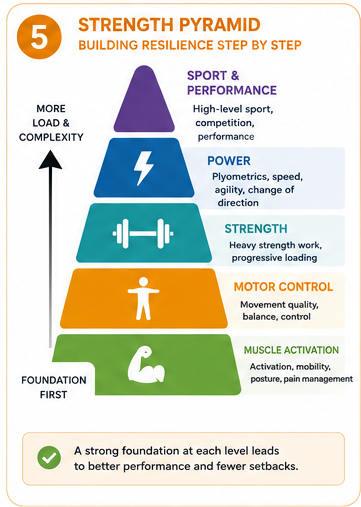
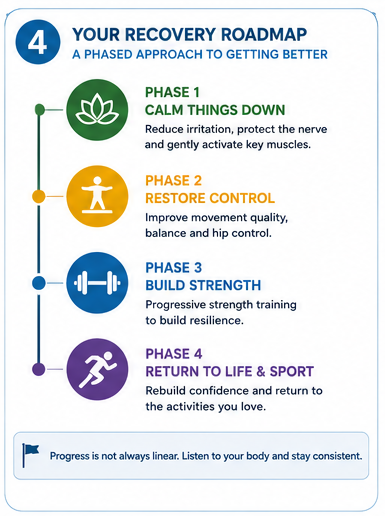
Our rehabilitation follows four key phases.