
Proximal Hamstring Tendinopathy

Understanding High Hamstring Pain: A Guide from Rebuild Physiotherapy
Proximal hamstring tendinopathy (PHT) is one of the most common causes of pain deep in the lower buttock. It is particularly common in runners, footballers, rugby players, tennis players and individuals who perform repeated sprinting, jumping or prolonged sitting. Although it can become a frustrating condition, the good news is that the vast majority of people recover well with an appropriately structured rehabilitation programme.
Hamstring Anatomy
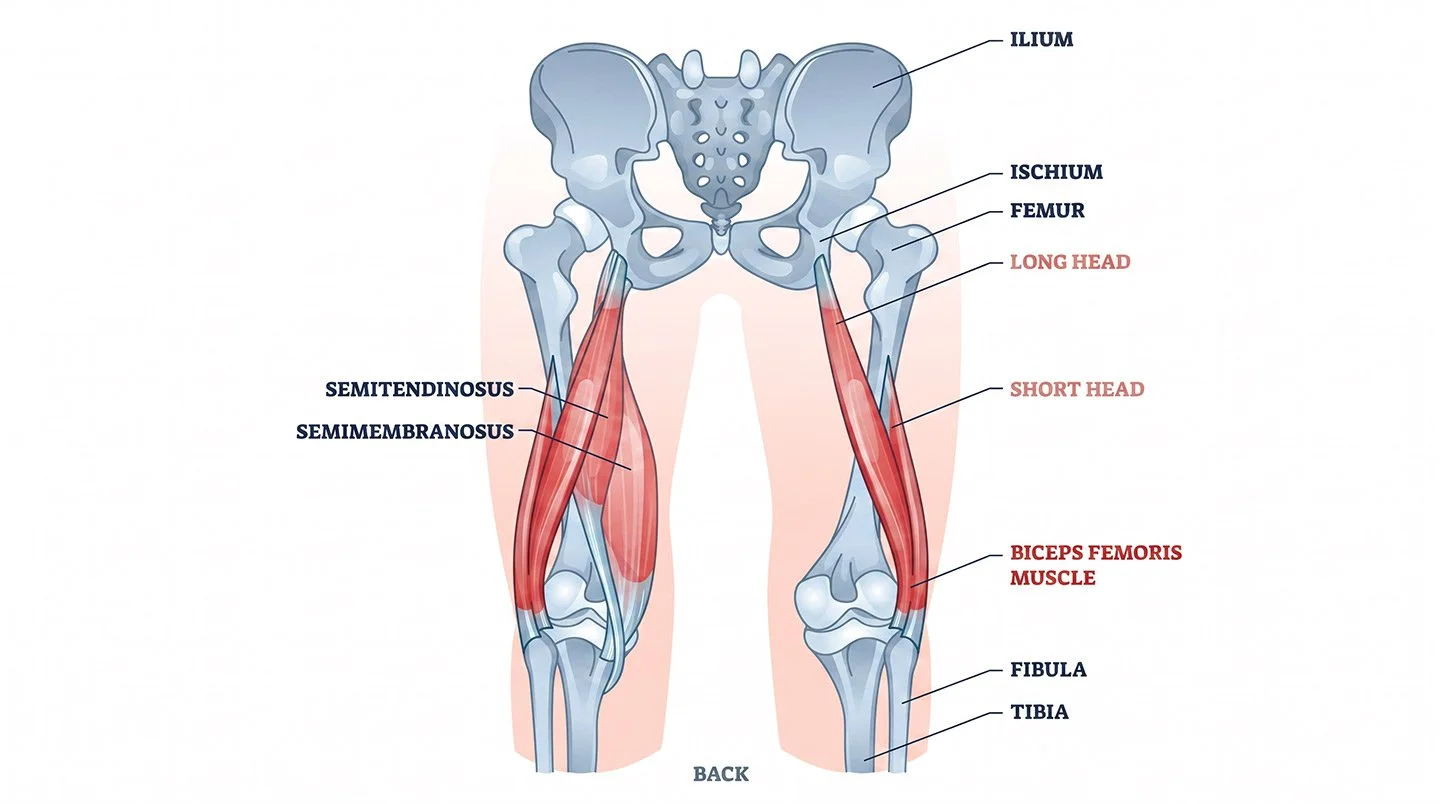
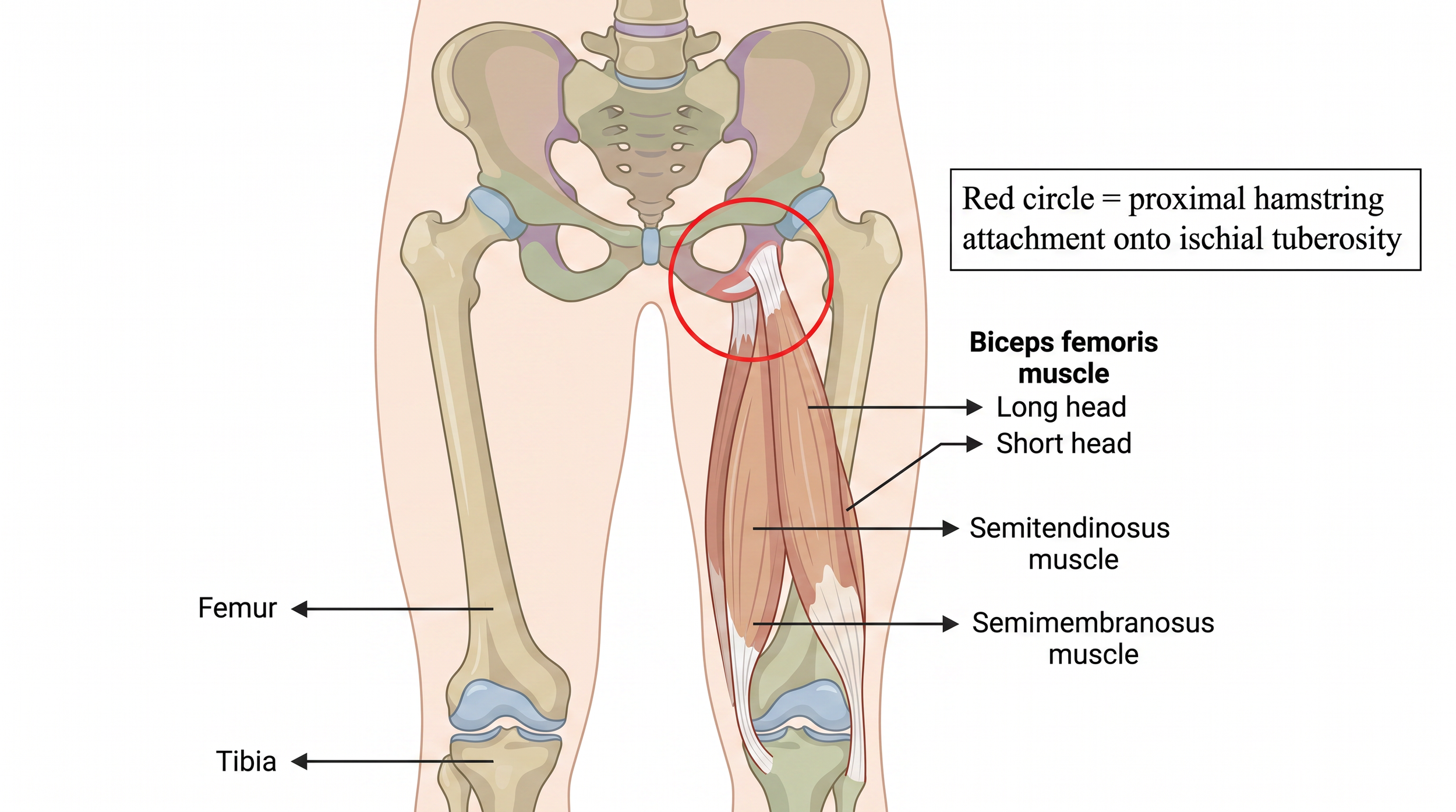
The hamstring muscle group consists of three muscles located at the back of the thigh:
Biceps Femoris (long head)
Semitendinosus
Semimembranosus
These muscles all originate from the ischial tuberosity (the sitting bone) via the proximal hamstring tendon before travelling down the back of the thigh to attach below the knee.
Their primary roles are to:
Bend the knee
Extend the hip
Decelerate the leg during running
Generate explosive power during sprinting and jumping
Stabilise the pelvis during walking and running
The proximal tendon is subjected to extremely high forces during running, especially at higher speeds.
What is Proximal Hamstring Tendinopathy?
Proximal hamstring tendinopathy is an overuse injury affecting the tendon where the hamstrings attach to the sitting bone.
Rather than being an inflammatory condition, modern research shows that tendinopathy represents a failure of the tendon to adapt to repeated loading.
The tendon undergoes changes including:
Disorganisation of collagen fibres
Reduced tendon stiffness
Increased tendon thickness
Small blood vessel and nerve ingrowth
Reduced ability to tolerate load
The tendon becomes sensitive because the amount of loading has exceeded its current capacity.
Simply resting often provides temporary relief, but symptoms usually return once activity resumes because the tendon has not regained its ability to tolerate load.
What Causes It?
The most common cause is a sudden increase in tendon loading.
Common contributors include:
Increasing running mileage too quickly
Sprint training
Hill running
Increased heavy gym work without adequate rest (or nutrition)
Football or rugby pre-season
Long periods of sitting
Premature returning to sport after injury
Reduced gluteal strength
Poor lumbopelvic control
Previous hamstring injury
It often develops gradually over weeks or months.
Signs and Symptoms
Typical symptoms include:
Deep pain at the bottom of the buttock
Pain directly over the sitting bone
Pain during prolonged sitting
Morning stiffness
Pain when accelerating or sprinting
Pain climbing hills
Pain during lunges or deadlifts
Tight feeling in the hamstring
Pain after activity rather than during it
Tenderness when pressing on the tendon
Symptoms usually warm up slightly during exercise before becoming worse afterwards.
Who Gets Proximal Hamstring Tendinopathy?
This condition commonly affects:
Distance runners
Sprinters
Football players
Rugby players
Tennis players
CrossFit athletes
Hockey players
Cyclists
Dancers
Active adults aged 30–60
It is particularly common during periods of rapid training progression.
How is it Diagnosed?
Physiotherapists diagnose proximal hamstring tendinopathy primarily through:
Detailed history
Physical examination
Functional testing
Strength assessment
Load tolerance testing
MRI or ultrasound scans may assist in difficult cases but are not always necessary.
Imaging findings do not always correlate with pain, meaning many people have tendon changes without symptoms.
Prognosis
Recovery depends on:
Duration of symptoms
Tendon irritability
Training loads
Exercise compliance
Typical recovery times are:
| Severity | Expected Recovery |
|---|---|
| Mild | 6–8 weeks |
| Moderate | 8–16 weeks |
| Long-standing | 3 – 18 months |
Most people make an excellent recovery when rehabilitation focuses on progressive loading rather than prolonged rest.
How Physiotherapy Helps
At Rebuild Physiotherapy, rehabilitation focuses on improving the tendon's capacity rather than simply reducing pain.
Treatment includes:
Education about tendon loading
Activity modification
Progressive strengthening
Hip and pelvic control
Running gait assessment
Return-to-running planning
Sprint progression
Sport-specific rehabilitation
Hands-on treatment may help reduce pain temporarily, but exercise remains the most effective long-term treatment.
Rehabilitation Pathway
Successful rehabilitation follows a gradual progression. Progression should be based on pain response rather than time alone. Mild discomfort during exercise (up to 3/10 pain) is often acceptable provided symptoms settle within 24 hours.
Phase 1 – Pain Reduction & Isometric Loading (Week 1–6)
Goals:
Reduce pain
Maintain muscle activation
Begin tendon loading
| Exercise | Prescription |
|---|---|
| Isometric bridge hold | 5 × 5 - 10 sec |
| Isometric hamstring/45 degree bridge hold | 5 × 5 - 10 sec |
| Standing hamstring isometric against wall | 5 × 5 - 10 sec |
| Side plank | 5 × 5 - 10 sec |
| Pallof press | 3 × 12 |
Avoid:
Sprinting
Hills
Heavy deadlifts
Deep lunges
Aggressive stretching
Phase 1b
| Exercise | Prescription |
|---|---|
| Isometric SL bridge hold | 5 × 5 - 10 sec |
| Isometric SL hamstring/45 degree bridge hold | 5 × 5 - 10 sec |
| Isometric rack pull | 5 × 5 - 10 sec |
| ½ Side plank clam | 5 × 5 - 10 sec |
Phase 2 – Control & Capacity (Week 6 – 12 )
Goals:
Restore movement quality
Improve tendon capacity
Build endurance
Begin gradual return to easy running if symptoms remain well controlled.
| Exercise | Sets x Reps |
|---|---|
| KB RDL (light) | 3 × 10 – 12 |
| Bridge walkouts (Hamstring sliders) | 3 × 8 |
| Swiss ball curls | 3 × 10 - 12 |
| Step-ups | 3 × 10 - 12 |
| Single-leg hamstring bridge | 3 × 10 – 12 |
| Copenhagen plank (modified) | 3 × 20 sec |
Phase 3 – Heavy Strength Development (Week 12 – 18)
Goals:
Increase tendon stiffness
Restore strength
Improve power production
Running progression:
Easy running
Tempo running
Strides
Moderate accelerations
| Exercise | Sets x Reps |
|---|---|
| Romanian deadlift | 4 - 5 × 1 - 5 |
| Barbell hip thrust | 4 - 5 × 1 - 5 |
| Single-leg Romanian deadlift | 3 × 8 |
| Nordic hamstring curl | 3 × 5–8 |
| Bulgarian split squat | 4 - 5 × 1 - 5 |
| Any double leg squat variation | 4 - 5 × 1 - 5 |
Phase 4 – Energy Storage, Plyometrics & Return to Sport
Goals:
Restore high-speed hamstring function
Improve tendon energy storage and release
Develop explosive power
Build confidence with sprinting and change of direction
Prepare for unrestricted return to sport
As symptoms settle and strength has been restored, the rehabilitation focus shifts from producing force to producing force quickly. During sprinting, jumping and cutting, the hamstrings must absorb and generate very high loads over extremely short periods of time. Plyometric and ballistic exercises help prepare the tendon for these demands by improving the rate of force development, tendon stiffness and neuromuscular control.
Plyometric Progression
Begin with lower-level plyometrics before progressing to more demanding single-leg and multidirectional exercises.
| Exercise | Sets × Reps |
|---|---|
| Pogos (double-leg ankle hops) | 3 × 20 |
| Box jumps | 3 × 5 |
| Countermovement jumps | 3 × 5 |
| Hex bar jumps (20–30% body weight) | 3 × 5 |
| Broad jumps | 3 × 5 |
| Continuous vertical jumps | 3 × 8 |
Single-Leg & Ballistic Progression
Progress towards exercises that place greater demands on the hamstring during landing, propulsion and deceleration.
| Exercise | Sets × Reps |
|---|---|
| Single-leg hops (forward) | 3 × 8 each side |
| Lateral single-leg hops | 3 × 8 |
| Triple hop for distance | 3 × 5 |
| Bounding | 3 × 20–30 m |
| Hurdle hops | 3 × 6 |
| Skater jumps | 3 × 8 each side |
Running & Sport Progression
Once plyometric loading is well tolerated, gradually reintroduce high-speed running and sport-specific drills.
Progress through:
Jogging
Tempo running
Strides (60–70% effort)
Accelerations
Decelerations
Maximal sprinting
Change-of-direction drills
Position-specific drills
Full team training
Return to unrestricted competition
Return-to-Sport Criteria
Before returning to full competition, the athlete should demonstrate:
Minimal or no pain during training and the following day
Symmetrical hamstring strength compared with the opposite limb
Confidence during sprinting, jumping and cutting
Successful completion of maximal sprint efforts without symptom flare-up
Ability to tolerate repeated high-speed efforts and a full training session
Clearance from their physiotherapist based on functional performance rather than time alone.
Phase 5 – Energy Storage & Return to Sport
Goals:
Restore high-speed function
Prepare for competition
Develop resilience
Return to sport should be based on achieving:
Full strength
Minimal pain
Equal performance between legs
Confidence with sprinting
Ability to complete full training sessions without symptom flare-up
| Exercise | Sets x Reps |
|---|---|
| Bounding | 3 × 20 m |
| Single-leg hops | 3 × 10 |
| Sprint accelerations | Progressive |
| Deceleration drills | Progressive |
| Change-of-direction drills | Progressive |
| Maximal sprinting | Gradual exposure |
Tips for Recovery
Avoid complete rest unless pain is severe.
Progress training gradually and avoid sudden spikes in running volume or intensity.
Reduce prolonged sitting where possible, or use a cushion to reduce pressure on the tendon.
Prioritise sleep, nutrition and recovery to support tendon healing.
Monitor symptoms—pain that settles within 24 hours after exercise is generally acceptable during rehabilitation.
Stay consistent. Tendons adapt slowly, and regular progressive loading is the key to long-term recovery.
When Should You See a Physiotherapist?
If buttock or upper hamstring pain has persisted for more than two weeks, is limiting your running or sport, or keeps returning despite rest, a thorough physiotherapy assessment can help identify the underlying cause and guide an effective rehabilitation programme.
At Rebuild Physiotherapy, we combine detailed movement assessment, evidence-based tendon rehabilitation and sport-specific return-to-performance planning to help you recover safely, rebuild strength and return to the activities you enjoy with confidence.