
Strength in Rehabilitation: Page 5 - how to design a program
How to design your program?
Structuring the Program
Each session includes one squat pattern, one hinge pattern, and one lunge pattern, with 2–3 sessions completed per week.
Exercise Selection & Programming
Squat Pattern (Bilateral Knee-Dominant)
Examples include box squats, leg press, back squats, front squats, and goblet squats as a regression, programmed with a strength focus of 4–5 sets of 3–5 reps with 3 minutes’ rest, progressing gradually from leg press to box squat, goblet squat, front squat, and finally back squat while adding load over time.
Hinge Pattern (Hip-Dominant)
Examples include rack pulls, hex bar deadlifts, deadlifts, Romanian deadlifts, and hip thrusts, programmed as 4 sets of 3–5 reps for the hex bar deadlift or 3–4 sets of 3–5 reps for RDLs, with a key focus on developing the posterior chain, including the glutes and hamstrings, while maintaining good spine control.
Lunge Pattern (Unilateral Strength)
Examples include step ups, single-leg leg presses, split squats, walking lunges, and reverse lunges, programmed as 3–4 sets of 3–8 reps on each leg with slightly higher reps to improve control and stability, progressing from bodyweight to loaded, deficit, and dynamic variations.
Strength Focus Example Session
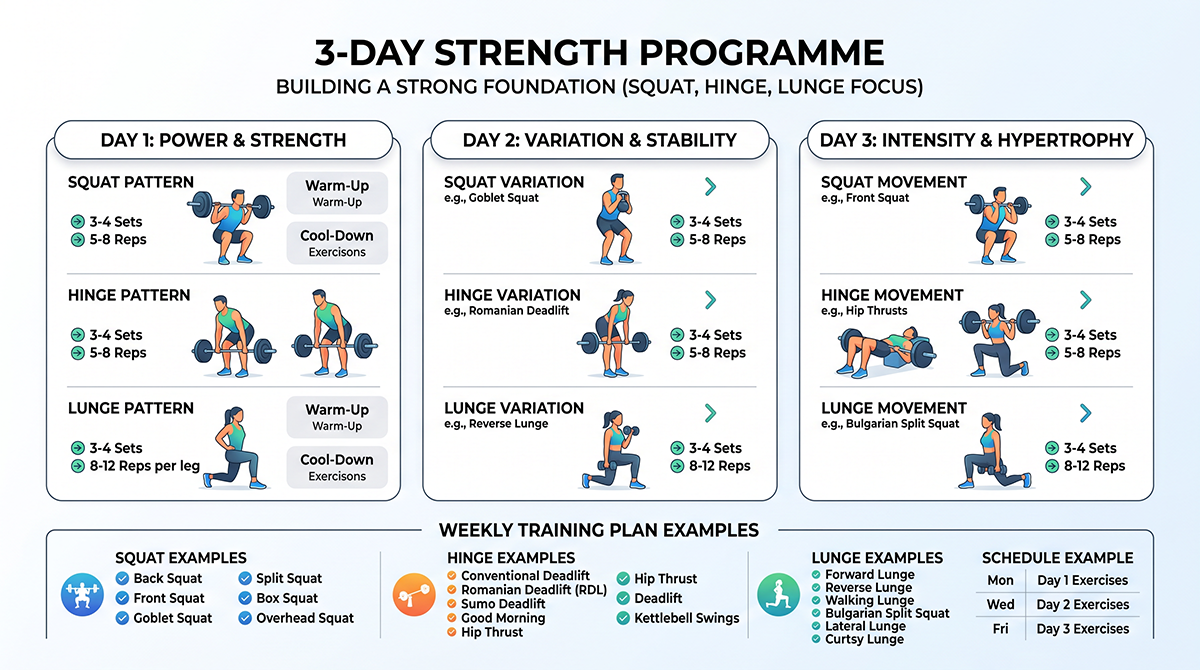
to work all movements in one session
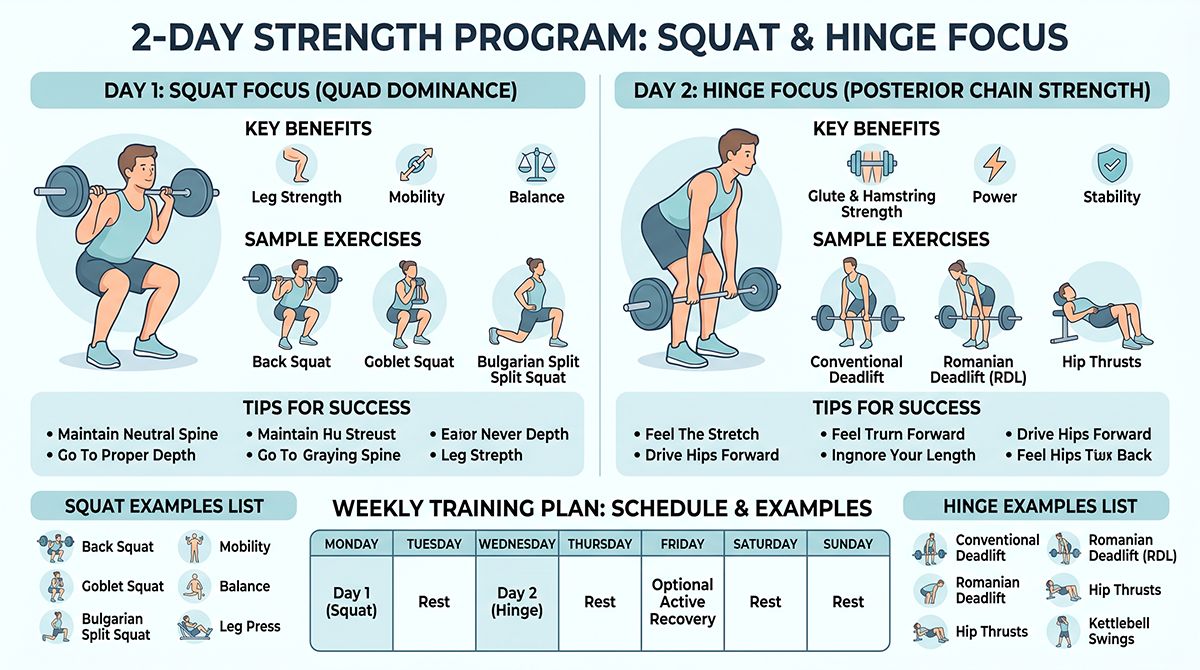
For a two day a week program with squat and hinge dominant days, please see the infographic above.
A1. Box Squat: 5 × 3 reps (heavy)
B1. Hex bar Deadlift: 4 × 5 reps
C1. Step up: 3 × 6 each leg
Optional Accessory: Leg extension or leg curl
Progressive session
A2. Back Squat: 5 × 3 reps (heavy)
B2. Romanian Deadlift: 4 × 5 reps
C2. Split Squat: 3 × 6 each leg
Optional Accessory: Calf raises or core work
Progression Model (4–6 Weeks)
Week 1: Moderate load (build technique)
Week 2–3: Increase load
Week 4: Peak intensity
Week 5: Deload (reduce volume/load)
Week 6: Rebuild / test
Rehab-Specific Considerations
Start with higher reps (6–10) if pain or low tolerance
Use isometrics early if needed
Progress → heavy strength (1–5 reps) when tolerated
Prioritise single-leg (lunge) for return to function
Key Takeaway
A strong program is built on:
Movement patterns (squat, hinge, lunge)
Heavy loading (for strength)
Progressive overload
Consistency + recovery
After many years of working with both sporting and healthcare clients—and managing my own injuries—I’ve found that a simple, effective approach works best.
My preferred strength training setup is a two-day-per-week program built around key movement patterns. Each session focuses on either a squat or hinge emphasis, with lunge variations included to develop unilateral strength and control.
This approach allows you to build strength in a balanced, practical way that transfers well to everyday life and sport.
The infographic below outlines how you can structure your own program using these movement principles. The goal is simple: help you get stronger, move better, and return to the activities you enjoy—or prepare for more sport-specific training.
There’s no single “right” way to do this. The most effective program is one that fits your lifestyle and is enjoyable enough to stay consistent with.
If you would like to know more, please contact me via this website.
References
Andersen, V., Fimland, M.S., Mo, D.A., Iversen, V.M., Vederhus, T., Hellebø, L.R.R., Nordaune, K.I. and Saeterbakken, A.H., 2018. Electromyographic comparison of barbell deadlift, hex bar deadlift, and hip thrust exercises: A cross-over study. The Journal of Strength & Conditioning Research, 32(3), pp.587-593.Baechle, T.R. and Earle, R.W. eds., 2008. Essentials of strength training and conditioning. Human kinetics.Camara KD, Coburn JW, Dunnick DD, Brown LE, Galpin AJ, Costa PB. An examination of muscle activation and power characteristics while performing the deadlift exercise with straight and hexagonal barbells. The Journal of Strength & Conditioning Research. 2016 May 1;30(5):1183-8.Currier, B.S., D’SOUZA, A.C., Singh, M.A.F., Lowisz, C.V., Rawson, E.S., Schoenfeld, B.J., Smith-Ryan, A.E., Steen, J.P., Thomas, G.A., Triplett, N.T. and Washington, T.A., 2026. American College of Sports Medicine Position Stand. Resistance Training Prescription for Muscle Function, Hypertrophy, and Physical Performance in Healthy Adults: An Overview of Reviews. Medicine and Science in Sports and Exercise, 58(4), p.851.Maestroni, L., Read, P., Bishop, C., Papadopoulos, K., Suchomel, T.J., Comfort, P. and Turner, A., 2020. The benefits of strength training on musculoskeletal system health: practical applications for interdisciplinary care. Sports Medicine, 50(8), pp.1431-1450.NSCA-National Strength & Conditioning Association ed., 2012. Essentials of strength training and conditioning. Human kinetics.Nuzzo, J.L., Pinto, M.D., Kirk, B.J. and Nosaka, K., 2024. Resistance exercise minimal dose strategies for increasing muscle strength in the general population: an overview. Sports Medicine, 54(5), pp.1139-1162.Reggiani, C. and Schiaffino, S., 2020. Muscle hypertrophy and muscle strength: dependent or independent variables? A provocative review. European journal of translational myology, 30(3), p.9311.Rossi, F.E., Schoenfeld, B.J., Ocetnik, S., Young, J., Vigotsky, A., Contreras, B., Krieger, J.W., Miller, M.G. and Cholewa, J., 2018. Strength, body composition, and functional outcomes in the squat versus leg press exercises. J Sports Med Phys Fitness, 58(3), pp.263-70.Saville (2025). Force velocity curve. Available at: https://www.scienceforsport.com/force-velocity-curve/Schoenfeld, B.J., Grgic, J., Ogborn, D. and Krieger, J.W., 2017. Strength and hypertrophy adaptations between low-vs. high-load resistance training: a systematic review and meta-analysis. The Journal of Strength & Conditioning Research, 31(12), pp.3508-3523.Stock, M.S., Bodden, M.E., Bloch, J.M., Starnes, K.L., Rodriguez, G. and Girts, R.M., 2022. Acute, non-specific low back pain does not impair isometric deadlift force or electromyographic excitation: a cross-sectional study. Sports, 10(11), p.168.Stone, M.H., Hornsby, G., Mizuguchi, S., Sato, K., Gahreman, D., Duca, M., Carroll, K., Ramsey, M.W., Stone, M.E. and Haff, G.G., 2024. The Use of Free Weight Squats in Sports: A Narrative Review—Squatting Movements, Adaptation, and Sports Performance: Physiological. The Journal of Strength & Conditioning Research, 38(8), pp.1494-1508.Swinton, P.A., Stewart, A., Agouris, I., Keogh, J.W. and Lloyd, R., 2011. A biomechanical analysis of straight and hexagonal barbell deadlifts using submaximal loads. The Journal of Strength & Conditioning Research, 25(7), pp.2000-2009.Tataryn, N., Simas, V., Catterall, T., Furness, J. and Keogh, J.W., 2021. Posterior-chain resistance training compared to general exercise and walking programmes for the treatment of chronic low back pain in the general population: a systematic review and meta-analysis. Sports medicine-open, 7(1), p.17.Welch, N., Moran, K., Antony, J., Richter, C., Marshall, B., Coyle, J., Falvey, E. and Franklyn-Miller, A., 2015. The effects of a free-weight-based resistance training intervention on pain, squat biomechanics and MRI-defined lumbar fat infiltration and functional cross-sectional area in those with chronic low back. BMJ open sport & exercise medicine, 1(1).Wirth, K., Hartmann, H., Sander, A., Mickel, C., Szilvas, E. and Keiner, M., 2016. The impact of back squat and leg-press exercises on maximal strength and speed-strength parameters. The Journal of Strength & Conditioning Research, 30(5), pp.1205-1212.