
Strength in Rehabilitation: Page 3 - Hinge
Hinge
A fundamental movement pattern involving flexion and extension at the hips while maintaining a neutral spine, where the hips act as the primary point of movement to control and generate force.
-
Hip dominance: Movement is driven mainly by the hip joint rather than the knees
Spinal stability: The spine remains neutral and stable throughout
Force production: Glutes and hamstrings generate power, especially during extension
Load distribution: Force is transferred efficiently through the posterior chain
Balance and control: Centre of mass shifts slightly backward while staying controlled over the base of support
-
Hexagonal (Hex) barbell dead reduced stress on the lumbar region, increased load lifted, while enhancing force, velocity, and power compared to Conventional Deadlift (Swinton et al 2011)
Conventional Deadlift increased normalised muscle activation at hamstrings and lumbar spine compared to Hex-bar Deadlift (Camara et al 2016)
Increased Glute Max in ConDL compared to Hex-bar Deadlift, but hip thrust more than Conventional Deadlift (Andersen et al 2018)
-
Below are some specific hinge techniques starting with low difficulty/skill and progressively increasing. The aim is to work hard, whilst keeping your pain low. In one work out you might choose 2 – 3 of the below exercises, discuss this with your physiotherapist. When starting off on an exercise program you may want to start on the least challenging exercise and develop capacity in your musculoskeletal system. If you have not been used to lift weights in the past you will progress quickly due to neural adaptations, it will however take a minimum of 6 weeks for any true muscular structural change.
Introduction to hinge
Double leg bridge
The deadlift
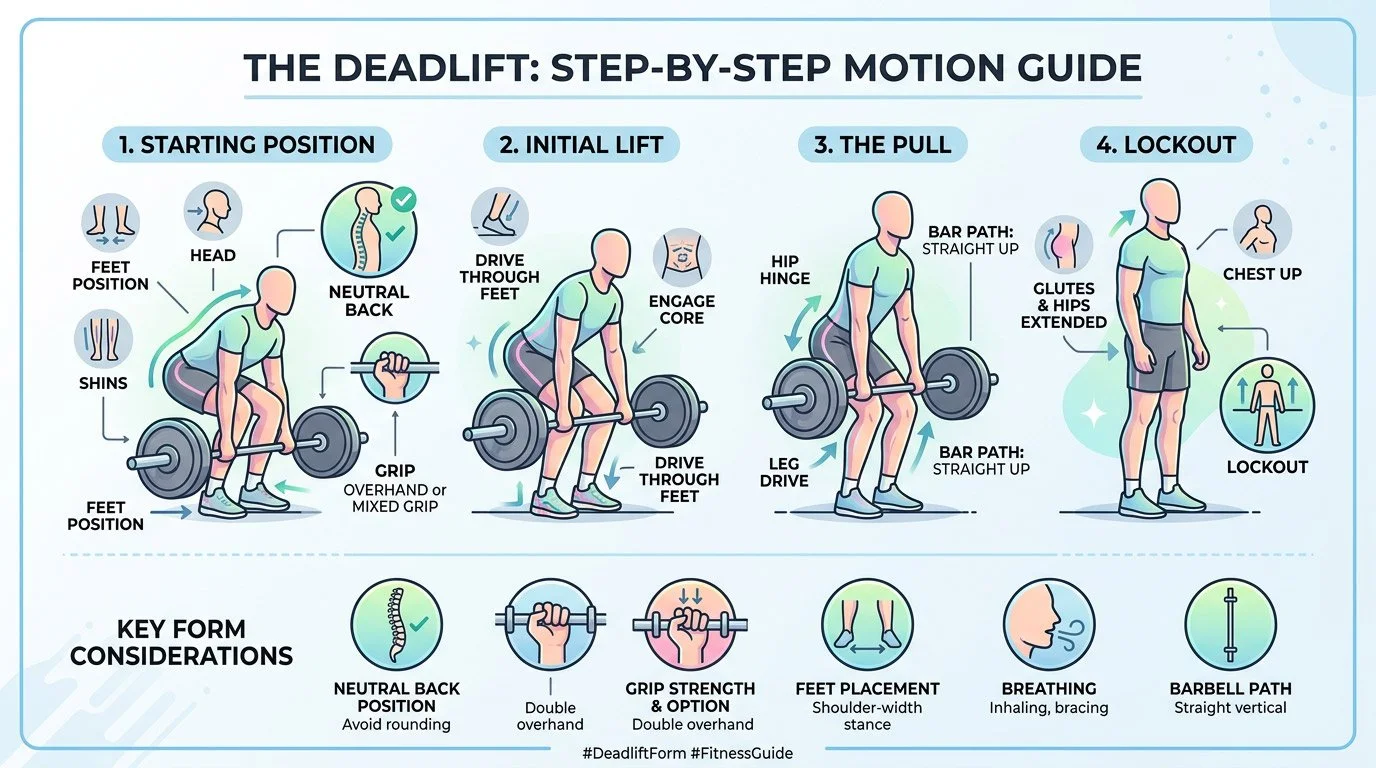
As mentioned in the myth section, people often believe that deadlifts are bad and or hurt their back. Reducing stress on your back during deadlifts is mostly about technique, setup, and appropriate loading. Done well, the deadlift should train your back—not strain it.
-
1. Maintain a Neutral Spine
Keep your spine in a natural, neutral position (not rounded or over-arched)
Think: “chest up, ribs down, brace your core and long spine.”
Avoid looking too far up or down—keep your neck aligned.
2. Brace Your Core Properly
Before lifting, take a deep breath and brace your core like you’re about to be punched.
This increases intra-abdominal pressure and stabilises your spine.
Don’t suck your stomach in—push out against your belt (if using one).
3. Hinge at the Hips (Not the Lower Back)
Focus on a hip hinge rather than bending through your spine.'push a big button behind you with your bum'
Push your hips back while keeping the bar close to your body.
A great drill to learn this is the Romanian Deadlift.
4. Keep the Bar Close
The bar should stay almost touching your shins and thighs throughout the lift.
If it drifts forward, it increases stress on your lower back.
5. Use Your Legs First
Think: “push the floor away” rather than pulling with your back.
Your quads and glutes should initiate the lift—not your lumbar spine.
6. Don’t Lift Too Heavy Too Soon
Poor form under heavy load = higher injury risk.Master technique first, then gradually increase weight.
7. Control the Eccentric (Lowering Phase)
Don’t just drop the bar—hinge back and lower with control.
This reinforces good movement patterns and reduces strain.
8. Choose the Right Variation
If conventional deadlifts feel stressful, try:
Trap Bar Deadlift – more upright, less lower back stress
Sumo Deadlift – reduces spinal loading for some people
9. Address Mobility Limitations
Tight hamstrings or hips can force your back to compensate.
Regular mobility work helps maintain proper positioning.
10. Build Supporting Strength
Strengthen muscles that support your spine:
Lats (help keep the bar close), Glutes (e.g., Hip Thrust), Core (e.g., Plank)
Deadlift (hex bar)
Conventional Deadlift
(most trainers now have very large soles - almost turning the exercise to a deficit deadlift. Barefoot, flat sole or weight lifting shoes are often a lot more comfortable to do any deadlift exercises)
RDL
Hip thrust