
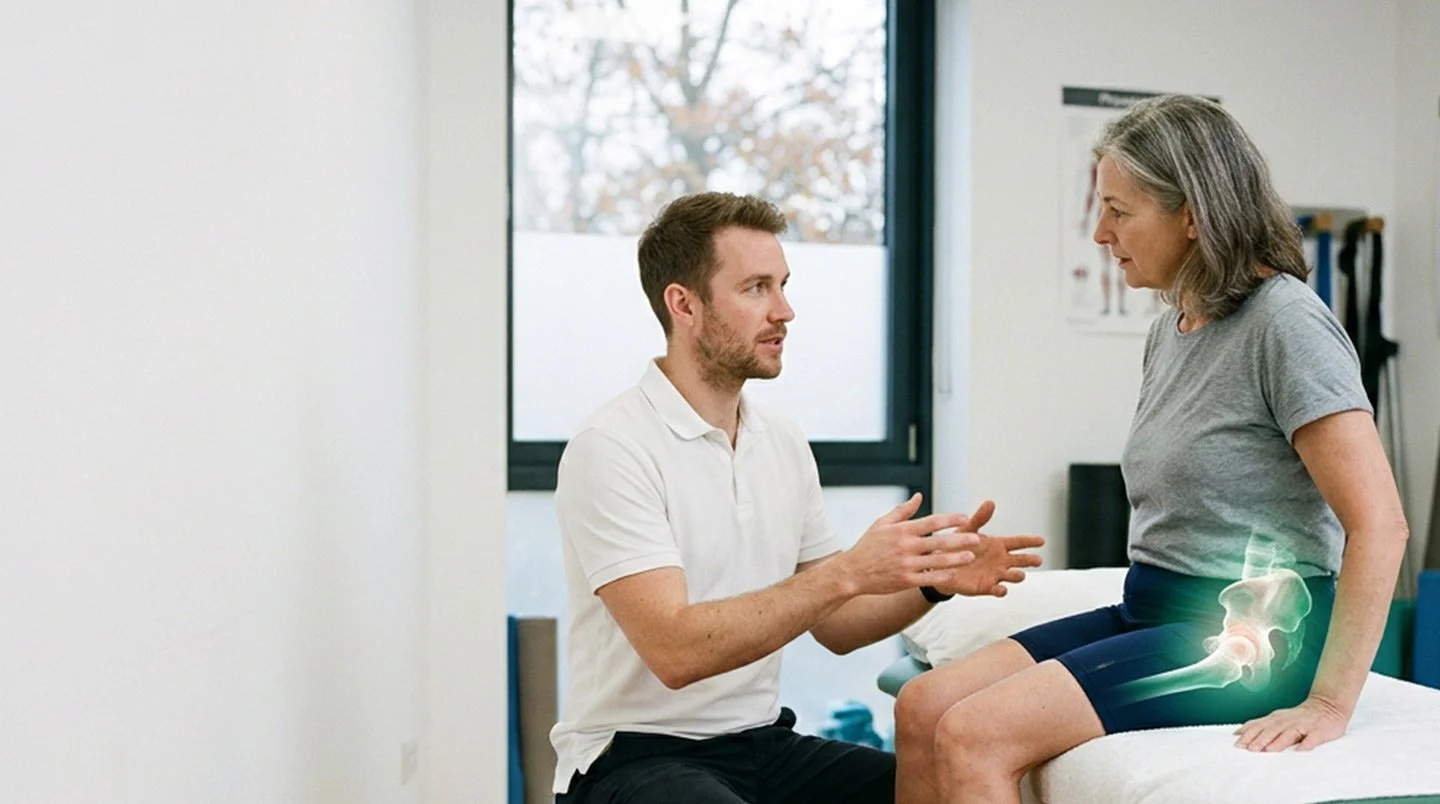
Phase 3: Motor Control, Early Strengthening and Functional Rehabilitation (Weeks 8 – 14/16)
This early phase focuses on waking the muscles up and promoting recovery following surgery. Gentle muscle activation helps stimulate the nervous system, maintain muscle connection and support circulation without placing excessive load through the healing tissues. Isometric exercises are particularly useful following a periacetabular osteotomy (PAO) as they allow muscles to work without significant joint movement, helping to maintain strength, reduce muscle inhibition and minimise early muscle loss while protecting the healing hip and pelvis. The aim is to activate, not exhaust—gradually restoring confidence and control before progressing to more demanding strengthening exercises.
Goals
Foundations for strength and endurance
Improve balance
Return to functional activities
Build confidence with movement
Physiotherapy Focus
Exercises progress to include:
Modified Squats
Hinge movements
Lunges (modified if needed)
Resistance band exercises
Single-leg balance work
Stationary cycling
Pool-based exercise if appropriate
Phase A
| Exercise | Duration | Reps | Sets | Frequency |
|---|---|---|---|---|
| Hip abduction supine | 5 –10 Secs | 5 | 3 | 2-3 x a day |
| Hip abduction crook lying | 5 –10 Secs | 5 | 3 | 2-3 x a day |
| Hip abduction bridge | 5 –10 Secs | 5 | 3 | 2-3 x a day |
| Hip flexion sitting | 5 –10 Secs | 5 | 3 | 2-3 x a day |
BOX SQUATS
Sit back to a box or bench, touch lightly and stand up. The box sets a consistent depth, which lets you load the hip confidently while controlling how far it bends.
SINGLE LEG BRIDGE
One foot planted and the other leg lifted, drive through the heel to raise the hips. Keep the pelvis level throughout rather than letting it drop.
LUNGES SUPPORTED (AIM TO DO INDEPENDENTLY WITH NO SUPPORT +/- WEIGHT)
Hold a rail or frame for balance and lower the back knee towards the floor. As control improves, reduce the support and then add weight.
KB RDL
Push the hips backwards with a soft knee, lowering the kettlebell close to the legs, then drive the hips forward to stand. Trains the hinge pattern behind most later strength work.
½ SIDE PLANK CLAM
In a side plank on the knees, lift the top knee while keeping the hips stacked and still. Targets the lateral hip muscles that control the pelvis during single leg loading.
Y – BALANCE (WHEN DONE)
Standing on one leg, reach the other foot out in three directions without losing balance or letting the standing knee collapse inwards. Tests and trains single-leg control in every direction.
Phase B
| Exercise | Duration | Reps | Sets | Frequency |
|---|---|---|---|---|
| Clam | 5 –10 Secs | 5 | 3 | 2-3 x a day |
| Hip abduction | 5 –10 Secs | 5 | 3 | 2-3 x a day |
| Hip flexion – ball against wall | 5 –10 Secs | 5 | 3 | 2-3 x a day |
| Staggered bridge | 5 –10 Secs | 5 | 3 | 2-3 x a day |
| Fire hydrant | 5 –10 Secs | 5 | 3 | 2-3 x a day |
| Wall sit | 5 –10 Secs | 5 | 3 | 2-3 x a day |